A tool for systematically generating balanced level structures for digital health interventions
APLES Overview
The APLES tool is a web application that leverages automated planning concepts to support the efficient structuring of balanced content progression in digital health interventions, based on rules and restrictions of the intervention designers. The tool enables the systematic generation of level-based content progressions that balance multiple dimensions such as difficulty, pacing, and fun ratio per level, simultaneously.
Key Features
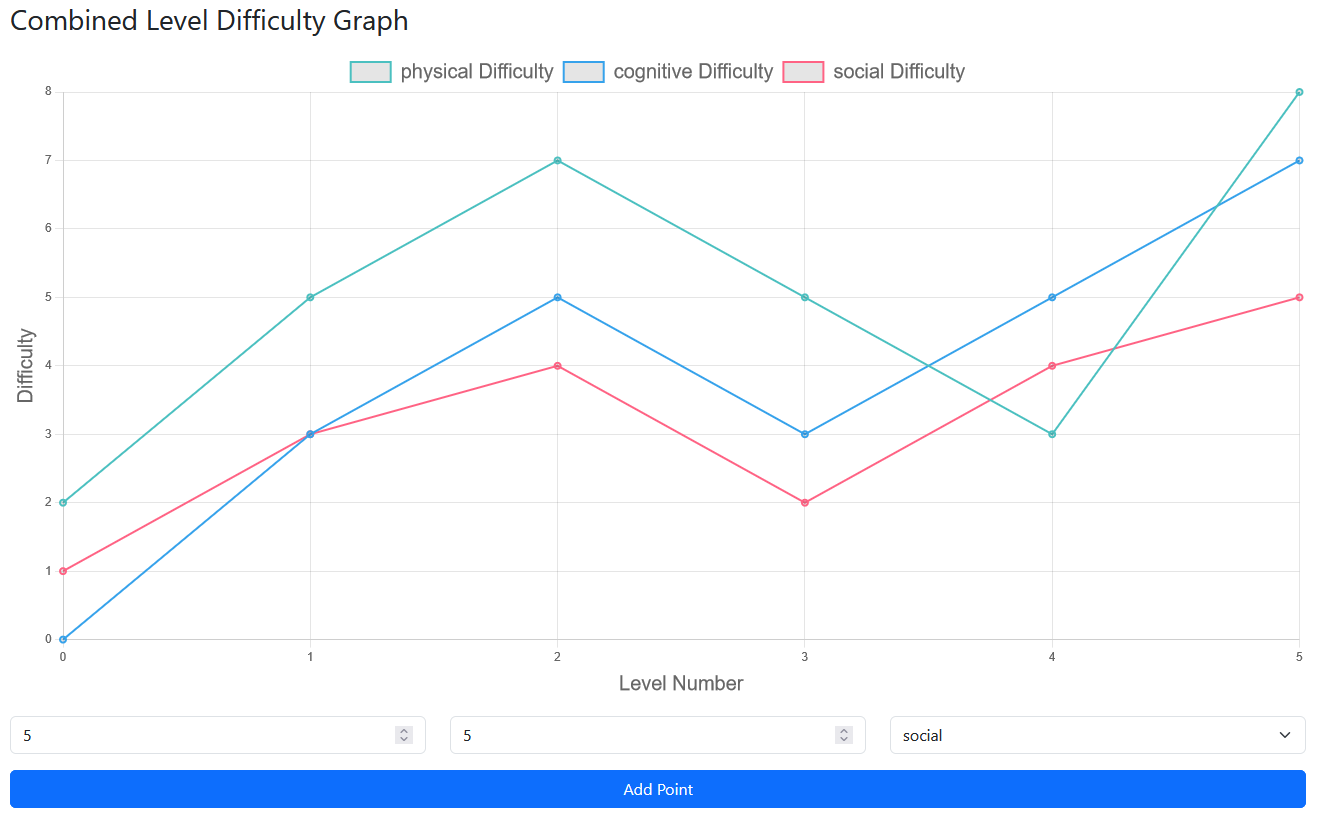
Health intervention designers can define the content progression of their intervention through an intuitive two-dimensional progression graph, which models how key dimensions are balanced across levels throughout the intervention.
The system supports multi-dimensional balancing, enabling designers to specify and control several dimensions of difficulty and engagement per level simultaneously.
APLES enables the translation of PDDL-based plans into deployable health interventions within supported platforms, such as GameBus Campaigns.
Key Contributions
Demonstrates that automated planning can be applied to generate structured level systems that adhere to designer-defined, integrating level design principles.
Provides a scalable method for content structuring, enabling consistent, rule-based, multi-dimensional level design without requiring labor-intensive manual configuration by case managers.
Research Context
Motivation
Designing balanced level structures for digital health interventions is challenging because multiple dimensions, such as difficulty, pacing, entertainment value, and alignment with intervention goals, must be balanced simultaneously to sustain engagement and to promote health outcomes. Balancing levels increase in complexity, the higher the number of activities and dimensions there are and as complexity increases, the process of balancing becomes difficult, time-consuming and is therefore not scalable.
APLES was developed to address this challenge by automating the structuring of intervention content based on predefined progression graphs. The tool aims to reduce manual design effort while supporting the creation of level structures that adhere to the rules and limitations of the intervention designers, while hiding the complexity of the balancing.
Theoretical Underpinning
APLES is grounded in behavior change theories used in game design. The tool uses level structures to guide users through progressive challenges that match their skill level and development, which is essential to motivate users according to flow theory and the progression principle. APLES uses the output of the 2D progression graph and models it as a state space problem, where each state represents a possible configuration of activities and pacing. State space problem can be represented as high-level problems using high-level planning languages such as PDDL. AI planning techniques could therefore be leveraged to generate solutions to systematically generate balanced level structures.
Technical Description
System Overview
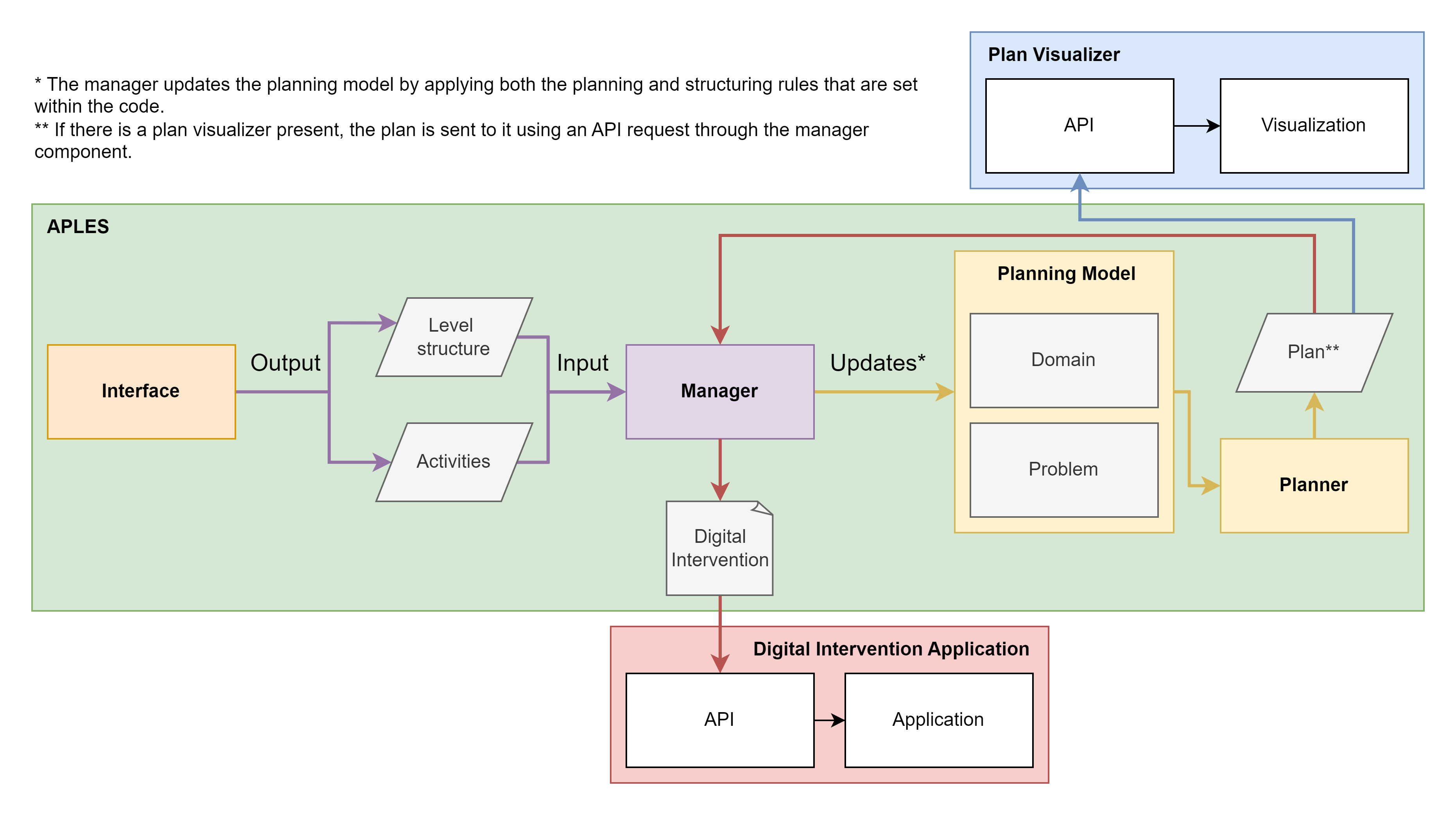
The APLES architecture is composed of several interconnected components that together enable the automated generation of balanced level structures for digital health interventions:
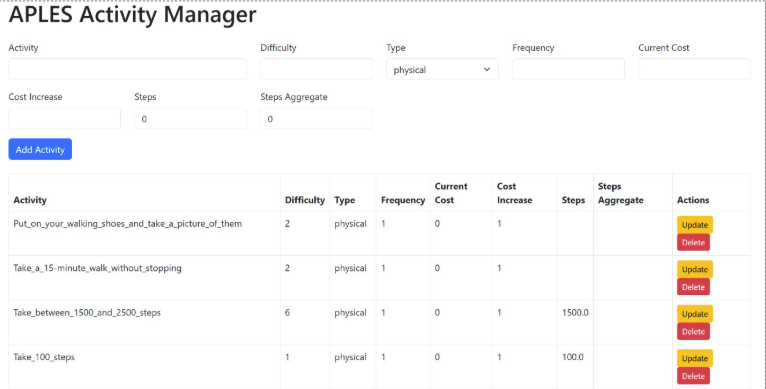
Interface: The interface allows designers or case managers to define and manage activities and level structure parameters. These serve as input for generating digital interventions.
Manager: The manager component receives input from the interface and updates the planning model by applying the defined structuring and planning rules. It coordinates communication between all APLES components and prepares the data for planning.
Planning Model: The planning model includes both the domain (which defines available actions and their effects) and the problem (which specifies the activities, rules, and target progression). This model is dynamically updated by the manager.
Planner: The planner solves the numeric planning problem defined in the planning model and generates a plan — a sequence of levels that satisfy the defined constraints and balance the specified dimensions, such as difficulty and fun ratio.
Plan Visualizer (optional): When available, the generated plan can be sent to an external visualization tool through an API to present the planned level structure graphically.
Digital Intervention Integration: The resulting plan is formatted as a digital intervention and can be exported to compatible health intervention platforms, such as GameBus, through an API for real-time deployment and tracking.
Core Technologies and Frameworks
The APLES system leverages classical planning techniques to systematically generate level structures for digital health interventions and gamified applications. In the thesis prototypes, the Unified Planning Framework for Python was used to create PDDL-based domain and problem definitions, and to solve the planning problem using the supported LPG and ENHSP planners. The web application was built using HTML and Bootstrap, while its API functionality is built using Python Flask. Data storage is handled using JSON and CSV files, maintaining activity information, pacing graphs, and generated sequences, which can be exported to external health interventions applications such as GameBus.
Demonstration Scenario: Using APLES to Design a Balanced Digital Health Intervention
To illustrate how APLES can be used in practice, consider a hypothetical digital health intervention called MoveQuest, designed to promote physical activity and cognitive well-being among university students. The intervention combines health-related activities (e.g., walking, stretching, mindfulness) with entertainment-based activities (e.g., short minigames) to maintain engagement over several weeks. The goal of the designers is to ensure that the pacing of difficulty and entertainment remains balanced throughout the intervention, in line with flow theory.
Step 1: Defining Activities and Attributes:
The design team begins by defining the available activities in the APLES interface. Each activity is assigned attributes such as type (physical, cognitive, or minigame), difficulty (ranging from 1 to 10), and fun score (ranging from 1 to 10).
“Take a 15-minute walk”, activity type: Physical, difficulty: 3, fun score: 4
“Play the “Balance Dash” minigame”, activity type: Minigame, difficulty: 2, fun score: 9
“Complete a guided breathing exercise”, activity type: Cognitive, difficulty: 1, fun score: 5
Step 2: Defining Pacing Rules:
Next, the designers specify the pacing graphs that describe how difficulty and fun should evolve during the course of the intervention, using the 2D progression graph.
Step 3: Generating the Level Structure:
Once the activity pool and pacing graphs are defined, the system’s PDDL Manager converts this input into a numeric planning problem. The planner (e.g., LPG or ENHSP) then computes an optimal sequence of activities that satisfies both the difficulty and fun ratio constraints. APLES outputs a structured level plan such as:
Level
Activity
Type
Difficulty
Fun Ratio
1
Play Balance Dash
Minigame
2
0.9
2
Take a 15-minute walk
Physical
3
0.4
2
Guided breathing
Cognitive
1
0.5
3
Balance Dash (hard mode)
Minigame
4
0.8
4
20-minute jog
Physical
5
0.3
Step 4: Exporting and Integration:
The generated plan is automatically converted into a JSON structure compatible with GameBus, enabling real-time progress tracking. Each level corresponds to a week in the intervention, where users unlock the next set of activities once the current ones are completed.
Step 5: Designer Review and Adjustment:
Designers can review the generated structure directly in the APLES frontend. If the pacing feels too steep or too repetitive, they can adjust the difficulty curve or fun ratio targets and re-run the planner. This iterative workflow allows them to fine-tune the level system without manually redesigning each stage.
Outcome:
By using APLES, the MoveQuest designers can quickly generate, verify, and adjust a level structure that maintains engagement while ensuring that the intervention goals are met. The tool allows them to reason systematically about pacing, balance, and engagement, reducing manual workload and increasing design consistency.
How to Use
The APLES tool is open source and ready to use. You can explore, modify, or integrate it into your projects:
The APLES github has both the front and backend of the system, however, support for health intervention applications other than GameBus needs to be extended by yourself. The github page can be found here:
https://github.com/Cryoscopic-E/APLES
Related Publications
James, L., 2021, December. Generating video game puzzles through planning. In UK PlanSIG 2021 (ONLINE): The second online Workshop of the UK Planning & Scheduling Special Interest Group.
James, L.J., De Pellegrin, E., Genga, L., Montagne, B., Van Gorp, P. and Petrick, R.P., 2024, November. Towards Automated Planning of Level Structures for Digital Interventions. In 12th Italian Workshop on Planning and Scheduling, IPS 2024 (pp. 74-88). CEUR-WS. org.
James, L.J., De Pellegrin, E., Genga, L., Montagne, B., Van Gorp, P. (2025). Automated Planning of Entertainment Content for Digital Health Interventions: A Technical Feasibility Study on Balance VS Fun. In: Sugimoto, M., Di Iorio, A., Figueroa, P., Yamanishi, R., Matsumura, K. (eds) Entertainment Computing – ICEC 2025. ICEC 2025. Lecture Notes in Computer Science, vol 16042. Springer, Cham. https://doi.org/10.1007/978-3-032-02555-5_14