A tool for creating and refining well-defined goals compatible with digital health intervention applications
GOALS system
The GOALS system is a web application that leverages LLM technologies to systematically create and refine well-defined personalized behavior goals, given an outcome goal as input. The system is designed to help facilitate case managers in the efficient co-creation of well-defined treatment plan goals with their clients who have been diagnosed with SMI.
Key Features
The GOALS system augments vague goals, such as “I want to be more social”, into well-defined goals that are grounded in behaviour change theory and are compatible with digital health interventions. Such as “Call a particular family member every Wednesday after work”
The system is capable of creating and refining deeply personalized goals using the internal and external contextual data of users, such as but not limited to their behavior toward completing goals, hobbies, friends, and location
The goal system leverages LLMs to significantly decrease the time and effort needed for individuals and/or healthcare personnel (or trained professionals) to create and refine well-defined goals based on behavior change theory, which is typically a labour-intensive task.
Key contributions
Healthcare personnel have evaluated the treatment plan goals generated by the GOALS system as significantly better than treatment plan goals co-created by case managers in collaboration with their clients.
The goals system has demonstrated that through prompt- and software- engineering, LLM-based goal creation systems can streamline the systematic creation of well-defined goals, improving on time-efficiently, while improving the quality of goals in treatment plans.
The GOALS system has demonstrated that LLM-generated goals have no significant negative impact on the engagement of participants in digital health interventions compared to general lifestyle goals.
Research Context
Motivation
We analyzed the quality of all the treatment plan goals within several FACT teams at a mental health hospital to determine their suitability for direct use in digital health interventions. The analysis revealed that only 20–25\% of treatment plan goals were well-defined. The majority of the goals lacked measurability, making them impossible to track, monitor, or complete in a structured digital format, limiting their use as personalized content in digital health applications. A key reason for the low number of well-defined goals is that co-creating measurable goals with clients is a time-consuming process, and case managers face heavy workloads that limit their time. This finding highlighted the need for tools or workflows to assist case managers in efficiently creating and refining well-defined treatment plan goals.
Theoretical Underpinning
The GOALS system is grounded in established theories of behavior change that explain how motivation and contextual factors drive sustained behavior change. The Self-Determination Theory (SDT) forms the motivational foundation, emphasizing that individuals are more likely to change behavior when three basic needs are met: when they feel autonomous, competent, and supported by their environment. The Fogg Behavior Model builds on this by highlighting that motivation and ability must coincide with external triggers, such as a digital intervention app, to initiate action. The Socio-Ecological Model (SEM) extends these principles by emphasizing the broader social and environmental contexts that shape an individual’s opportunities for change, while the Trans-Theoretical Model (TTM) shows that individuals at different stages of change have different needs and readiness levels.
Technical Description
System Overview
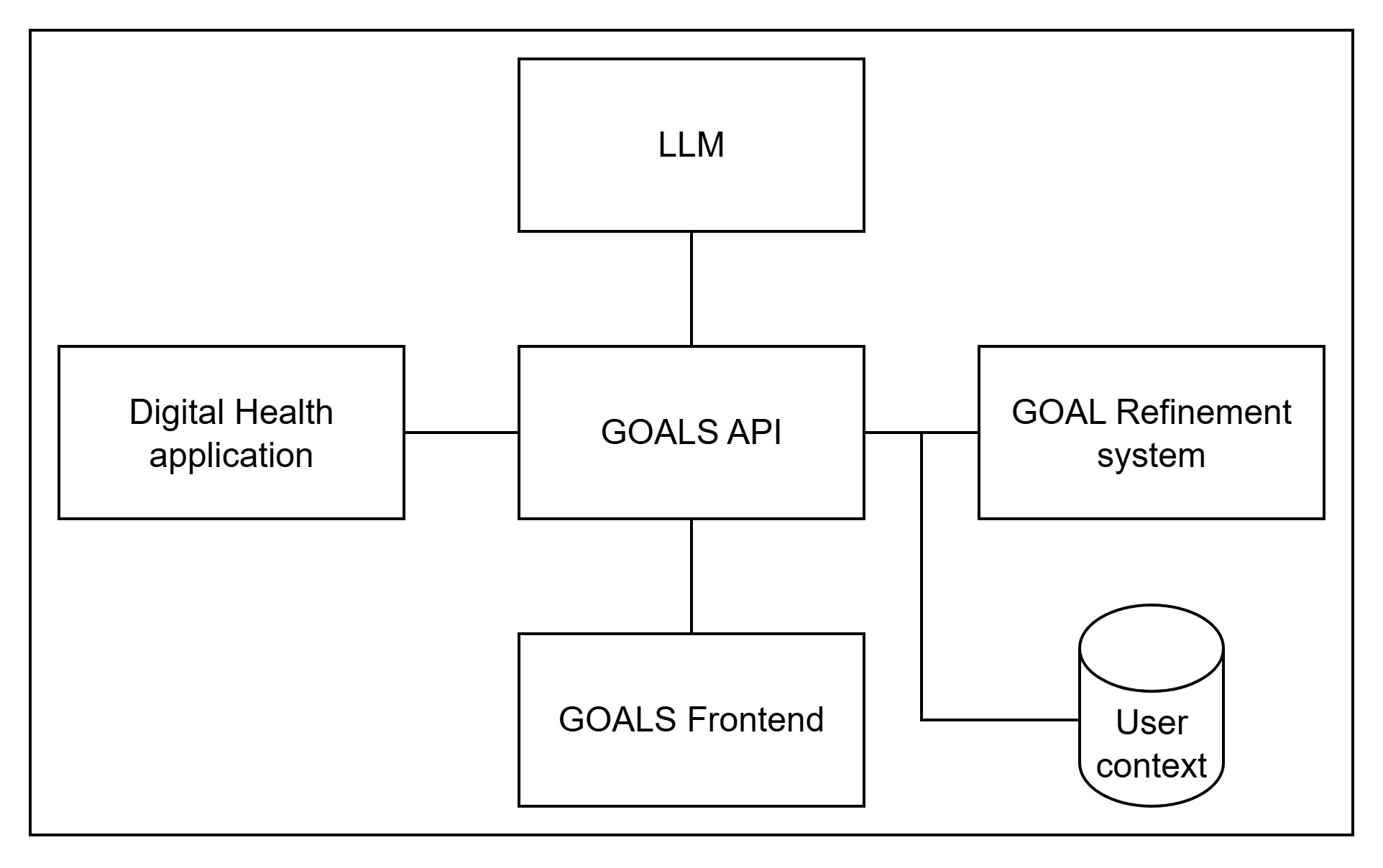
The GOALS system is designed to generate and manage personalized, measurable goals for individuals engaged in digital health interventions. Its architecture consists of several key components:
Large Language Model (LLM) – The system uses either a commercially hosted LLM (e.g., ChatGPT, Gemini) or an offline open-source model (e.g., DeepSeek LLaMA) to generate personalized goals based on user input and context.
GOALS Frontend – Provides interfaces for both individuals seeking goals and healthcare professionals managing goals. Users can input vague goals and additional context, while professionals can accept, edit, or remove goals and adjust system settings.
GOALS API – Handles communication between the frontend and the LLM. It constructs prompts using the individual’s context, goal descriptions, and any additional information from backend systems before sending them to the LLM.
Goal Refinement System – Determines when and how goals should be updated or refined. These settings are configurable by administrators through the frontend.
Digital Health Application Integration – Generated goals can be sent to intervention platforms like GameBus, allowing real-time tracking of user progress.
User Context Database – Stores contextual information about the individual, including progress, preferences, and prior goals. Currently implemented as flexible files or retrieval-augmented storage (RAGs) to provide additional context for goal generation.
Core Technologies and Frameworks
The GOALS system leverages both online and offline LLMs for goal generation. In the thesis prototypes, commercially hosted ChatGPT was used, while offline experiments utilized oLLaMA with RAG implemented in Python.
The backend API is responsible for preprocessing, validation, postprocessing, and prompt engineering, ensuring that generated goals are consistent with behavioral theory and measurable standards. Current implementations are built in Mendix, although earlier studies used Node.js for the API and plain HTML for the frontend.
The frontend system allows both individuals and healthcare professionals to input, review, and manage goals, including vague goal descriptions and contextual data.
The Goal Refinement System is rule-based and configurable via the frontend, determining when goals should be updated or adjusted to reflect changes in user context or progress.
Finally, data storage is handled using either flexible files or RAG systems for offline experiments, providing contextual information to the LLM to improve goal personalization and adaptation.
Example scenario
The following video displays the latest version of the GOALS system in action
How to use it
If you want to test out or even edit/modify the GOALS system the following code/projects are open source and ready to used:
The version of the GOALS system backend API used in the health intervention study: https://github.com/lorenzo456/GoalsAPI (This repository is private as it contains API keys, please contact me if you want access)
The version of the GOALS system used in the video (latest version): Download Mendix Project. This version is a Mendix project; you will need Mendix to run this version of the API, and you will also need to create your own ChatGPT API keys to make it work.
Related Publications
James, L.J., Genga, L., Montagne, B., Hagenaars, M. and Van Gorp, P., 2024, June. Caregiver's evaluation of LLM-generated treatment goals for patients with severe mental illnesses. In Proceedings of the 17th International Conference on PErvasive Technologies Related to Assistive Environments (pp. 187-190).
James, L.J., Maessen, M., Genga, L., Montagne, B., Hagenaars, M.A., Van Gorp, P.M.E. (2024). Towards Augmenting Mental Health Personnel with LLM Technology to Provide More Personalized and Measurable Treatment Goals for Patients with Severe Mental Illnesses. In: Salvi, D., Van Gorp, P., Shah, S.A. (eds) Pervasive Computing Technologies for Healthcare. PH 2023. Lecture Notes of the Institute for Computer Sciences, Social Informatics and Telecommunications Engineering, vol 572. Springer, Cham. https://doi.org/10.1007/978-3-031-59717-6_13
James, L.J., Genga, L., Montagne, B., Hagenaars, M.A., Van Gorp, P.M.E. (2025). Toward Scalable Content Generation for Gamified mHealth Interventions: The Evaluation of LLM-Generated Goals on User Engagement. In: Figueroa, P., Di Iorio, A., Guzman del Rio, D., Gonzalez Clua, E.W., Cuevas Rodriguez, L. (eds) Entertainment Computing – ICEC 2024. ICEC 2024. Lecture Notes in Computer Science, vol 15192. Springer, Cham. https://doi.org/10.1007/978-3-031-74353-5_7